May 3, 2026
Robots Will Enter Every Household
#周报
I have always been pessimistic about embodied AI in the short term. The market is exceptionally hot, startups are countless, and even many companies with little relevant business are investing. The industry’s most cutting-edge technology is still stuck at the lab-demo stage, and there’s no visible timetable for embodied AI to reach its ChatGPT moment.
Despite the short-term pessimism, lately I’ve increasingly felt that in the long run robots will definitely enter ordinary households. That long run may be on the scale of ten or twenty years — I can’t estimate the exact timing — but it will surely happen within my lifetime.
Why the shift in thinking? I think there are two main reasons.
First, the technology iteration cycle far exceeds expectations — new concepts appear every month. From simply adding an action head onto a VLM (which seemed like forcibly borrowing the VLM’s open semantic understanding and reasoning abilities) to today’s purposeful designs (including RL, in-context learning, world models). Confidence in the whole system keeps strengthening: with enough data and a reasonably efficient architecture, we can keep pushing algorithmic performance forward. In the long run, technology will not be the limiting factor. There’s even a notion like Robotics’ End Game: if we can leverage as much data as possible through architecture design (video, ego-centric, UMI, tele-op, etc.), plus post-training techniques like reinforcement learning, we can reach the end state. BTW, I don’t particularly buy the phrase Robotics’ End Game — it oversimplifies a complex problem — but I agree with the general direction: robotics (physical AI) will definitely be a solvable problem within the next 20 years.
Second, industry investment is enormous, especially in data collection. As analyzed above, the data gap is the most obvious first bottleneck. Right now enormous resources across the industry are being devoted to solving it, at a scale I hadn’t anticipated. The table below shows the major data-collection projects in China; I believe many more companies exist, and ego-centric data collection globally is likely at an even larger scale.
| Entity | Projected 2026 capacity (as reported) | Confirmed resource investment (publicly verifiable) | Planned future investment (public statements) |
|---|---|---|---|
| JD Group (embodied data collection program) | Phase one: about 5 million hours of real human-scenario video within 12 months of launch; >10 million hours total within 24 months, plus about 1 million hours of robot embodiment data in parallel. | Participants: over 100,000 internal employees + up to 500,000 external industry personnel; 100,000+ residents in the Suqian pilot; covering 100+ fine-grained scenarios. | Cumulative >10 million hours of human-side data + about 1 million hours of embodiment data over two years. |
| Mifeng Technology (Zhiyuan’s physical-AI data platform) | Media reports: “tens of millions of hours” of annual capacity in 2026 | Model: self-operated equipment and staff + partner assignment; MEgo series wearable collection hardware; | “Hive Data Co-creation Initiative”: a call for “tens of billions of hours” of ecosystem capacity by 2030 (alliance vision). |
| Zhiyuan Robotics (Shanghai Pudong data collection center) | Trajectory capacity: “tens of thousands of trajectories” uploaded to the cloud daily. Production-side G2 reported expansion of industrial deployment to 100 units in Q3 2026 | About 3,000 ㎡ (Pudong data collection center); 100+ robots collecting in parallel; | Data scale: accumulating toward hundreds of millions of trajectories; Mass production: reports mention goals like 100,000 units by end of 2027. |
| Beijing Humanoid Robot Innovation Center (Yizhuang data & training base) | Base goals point to the “world’s first million-hour-level” milestone (progress-type). | Phase-one floor area about 5,000 ㎡; 120+ multi-brand robots; 30+ reproducible scenarios; about 200 ㎡ optical motion-capture area; QC pass rate about 95% (after refinement). | Continued progress toward the million-hour high-quality embodied data goal; Yizhuang’s “social experiment” opening 30+ real training grounds (region-level). |
| National-Local Joint Humanoid Robot Innovation Center (Shanghai) / Diwuyaosu et al. (national center training grounds) | Per the National Data Administration’s typical-case disclosure at the time of filing: over 1 million clips, about 2.5 PB of real-robot multimodal data (clips ≠ hours); 2026 full-year incremental capacity not broken out in the case. | Training grounds over 5,000 ㎡; 100+ heterogeneous robots; unified data platform and governance standards. | The case emphasizes continued construction of high-quality datasets and a training-inference loop; no specific 2027+ hourly targets stated. |
To summarize: at least at the software-system level, embodied AI has no obvious limiting bottleneck — compute, algorithms, and data are all being positively addressed. For fully humanoid robots like Tesla’s Optimus, there may still be constraints in motors, batteries, and dexterous hands.
In the long run, the pace of technology adoption and its social impact are always underestimated — embodied AI is no exception. The vision of a robot in every home will absolutely come true.
This conclusion is actually quite obvious; some people could have deduced it months or even a year in advance. The reason I wrote this piece is that I’ve found when you stretch your horizon from the next year or two to five or ten years, many things change. Today’s uncertain technical challenges will most likely be solved in the long run. And from a long-term perspective, what truly matters stands out — the robotics industry’s prospects are genuinely vast (provided one survives the bursting of the bubble)!
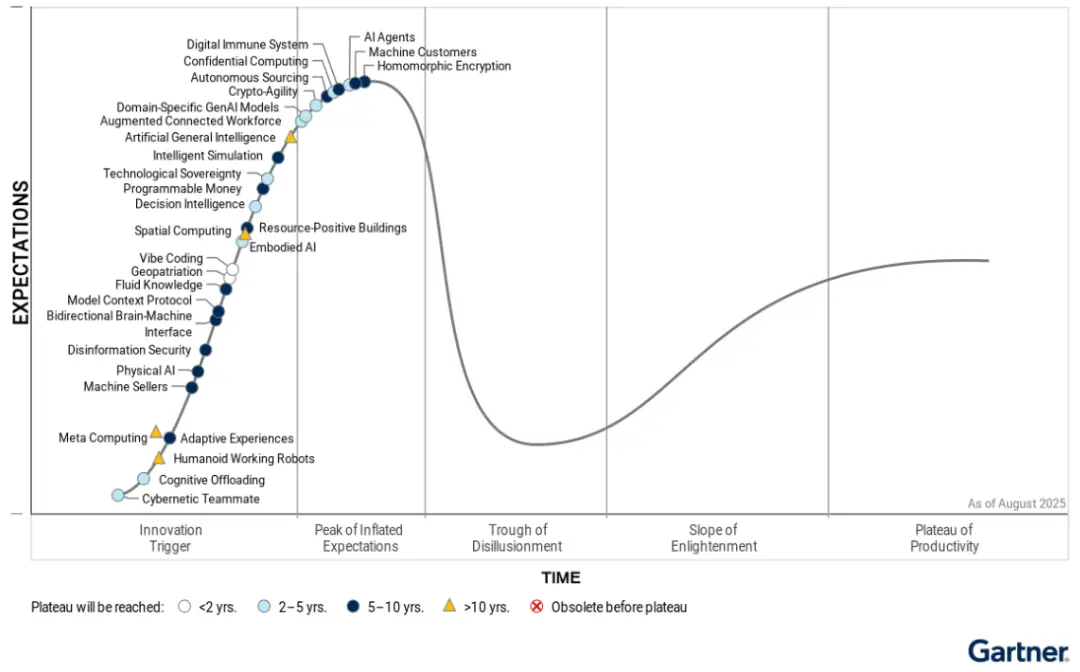
Attached: the 2025 Gartner Hype Cycle™ for Emerging Technologies