May 22, 2026
Is Teaching a Child Like Training an LLM?
#周报
My son is almost two — right at the stage of rapid cognitive development. I often compare a child’s development with the training of large models: the two have many similarities as well as huge differences. Every day I read storybooks to my son, even books he has already seen countless times.
There is one series of picture books densely packed with objects, showing people, things, and their states across various environments. I describe the objects in detail, and sometimes I ask questions, letting my son find a particular object. Clearly, this corresponds to two kinds of corpora in LLM training: captions and VQA. Captions describe an image — whole or in part — in fine detail, linking the visual and language modalities. VQA is vision-based question-answer pairs that strengthen the model’s understanding and localization of image information.
If my storytelling to my child meets the training-corpus requirements of a VLM, then naturally I’m curious: first, can my daily stories be converted into training corpora for large models? And second, if so, roughly how difficult are they? On a few mornings this week, while reading this picture-book series with my son, I recorded the whole process, hoping that later processing would answer these questions.
After transcribing the recordings and having a large model extract and summarize them, I found there are still considerable differences.
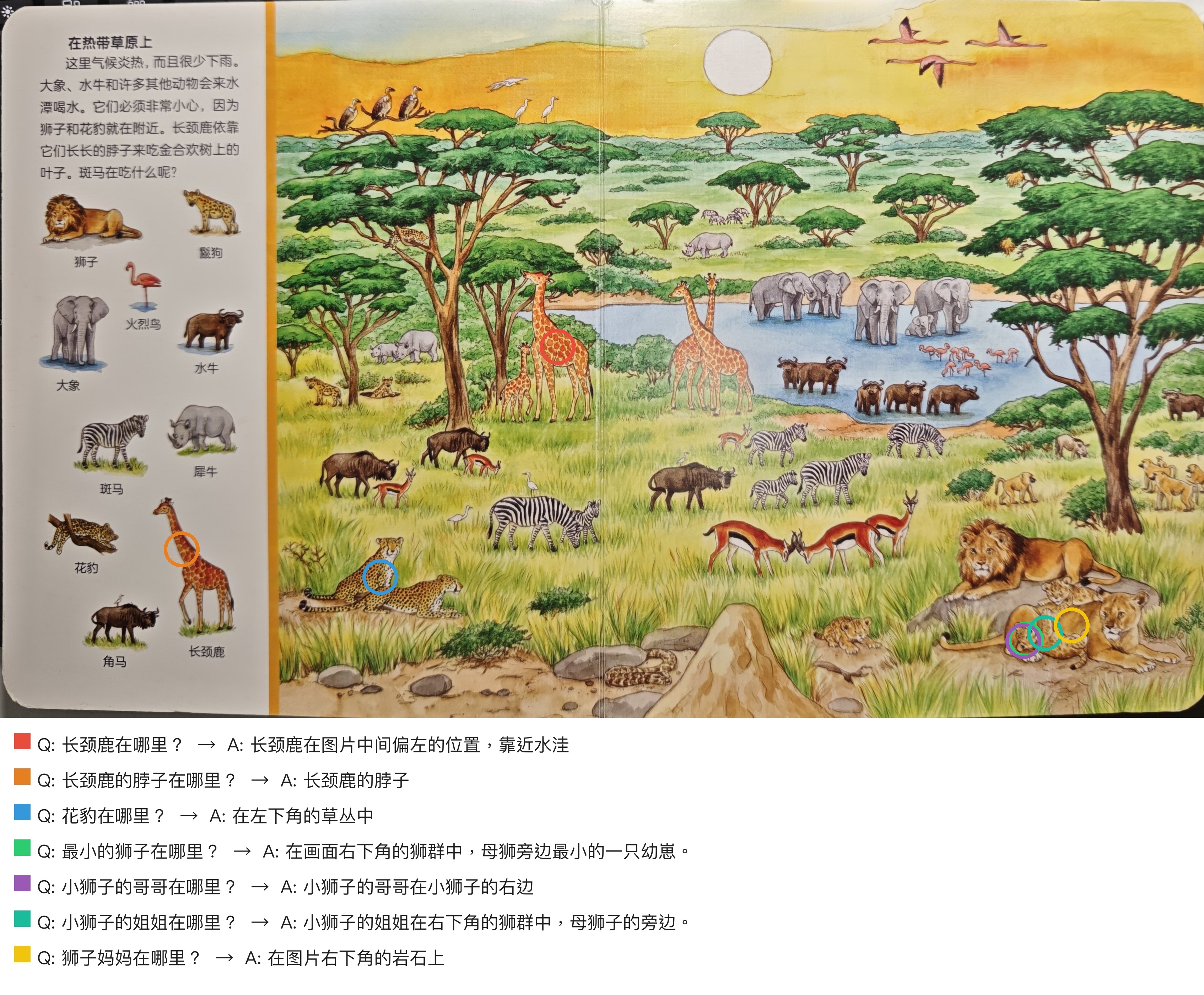
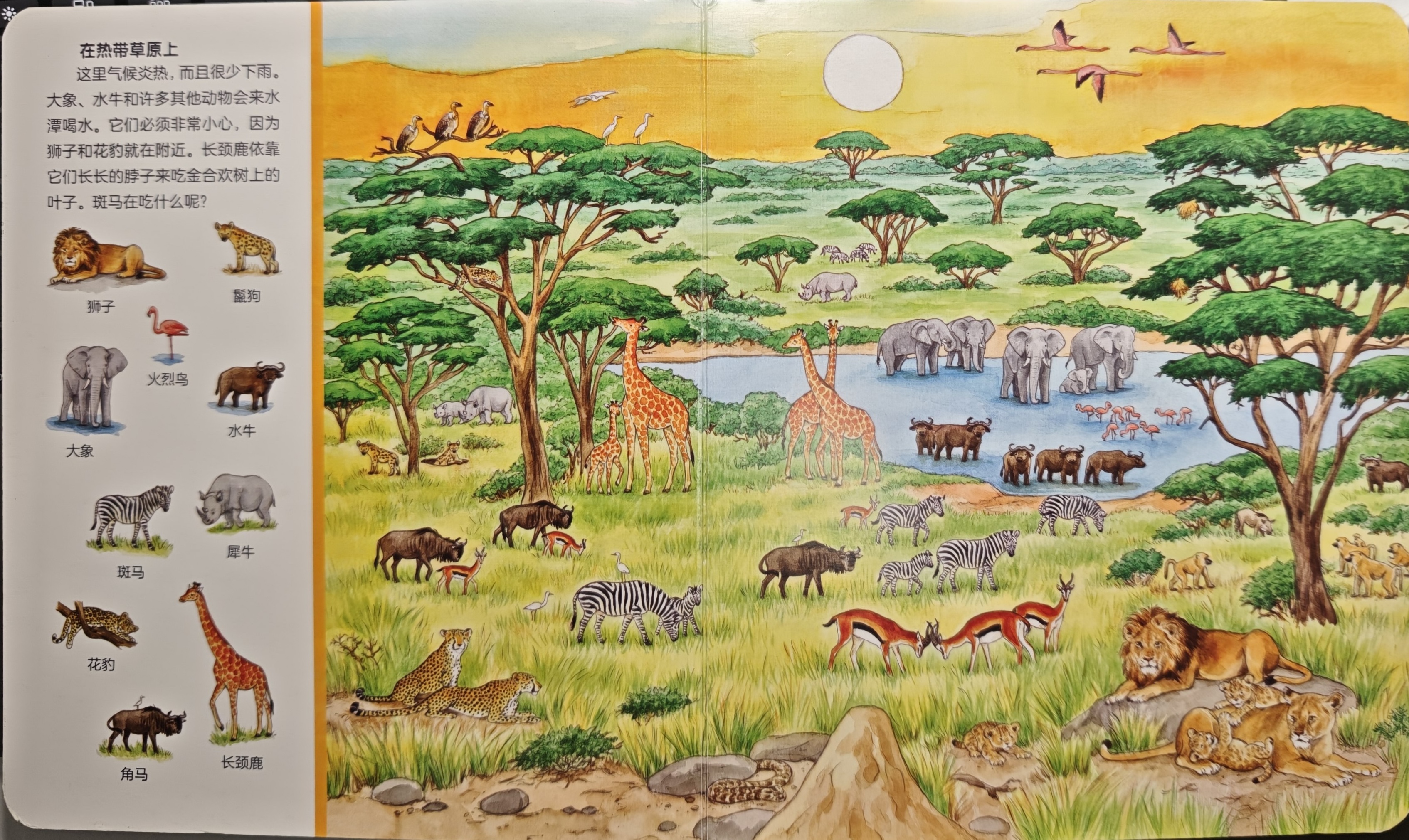 We spent two and a half minutes on this page. The extracted transcript follows (with some repetition and irrelevant content removed):
【Giraffe】
Me: Where is the giraffe? What’s long on the giraffe?
Child: (points to the location)
Me: Right, the giraffe’s neck is long. Its neck is here (pointing).
【Leopard】
Me: Where is the leopard?
Child: The leopard is here (pointing).
Me: Correct, the leopard is here (pointing). The leopard is hiding in the tree, watching for prey below. If prey comes, it whooshes out and eats them.
【Lion family】
Me: Where are the lions? Who is the smallest lion?
Child: This one is the lion cub (pointing).
Me: This is the smallest one. Where is its big brother?
Child: Here (pointing).
Me: Right, that’s his brother. And his sister?
Child: His sister is here (pointing).
Me: That’s not his sister — that’s the leopard. His sister is here (pointing). The whole lion family is here; this is the daddy lion. Which one is the mommy lion?
Child: (searching…)
Me: The mommy lion is here (pointing). Look, both babies are lying on their mommy.
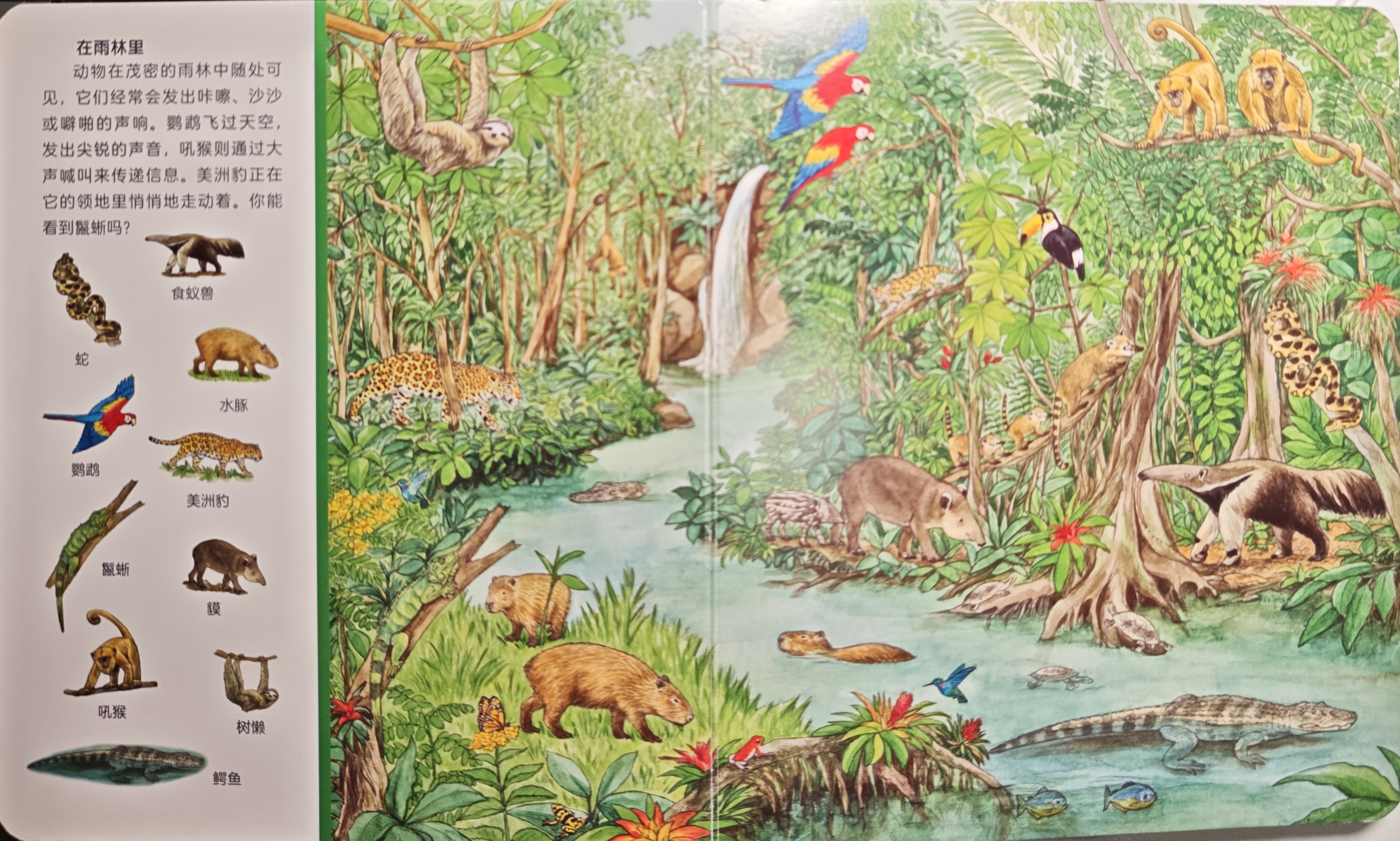
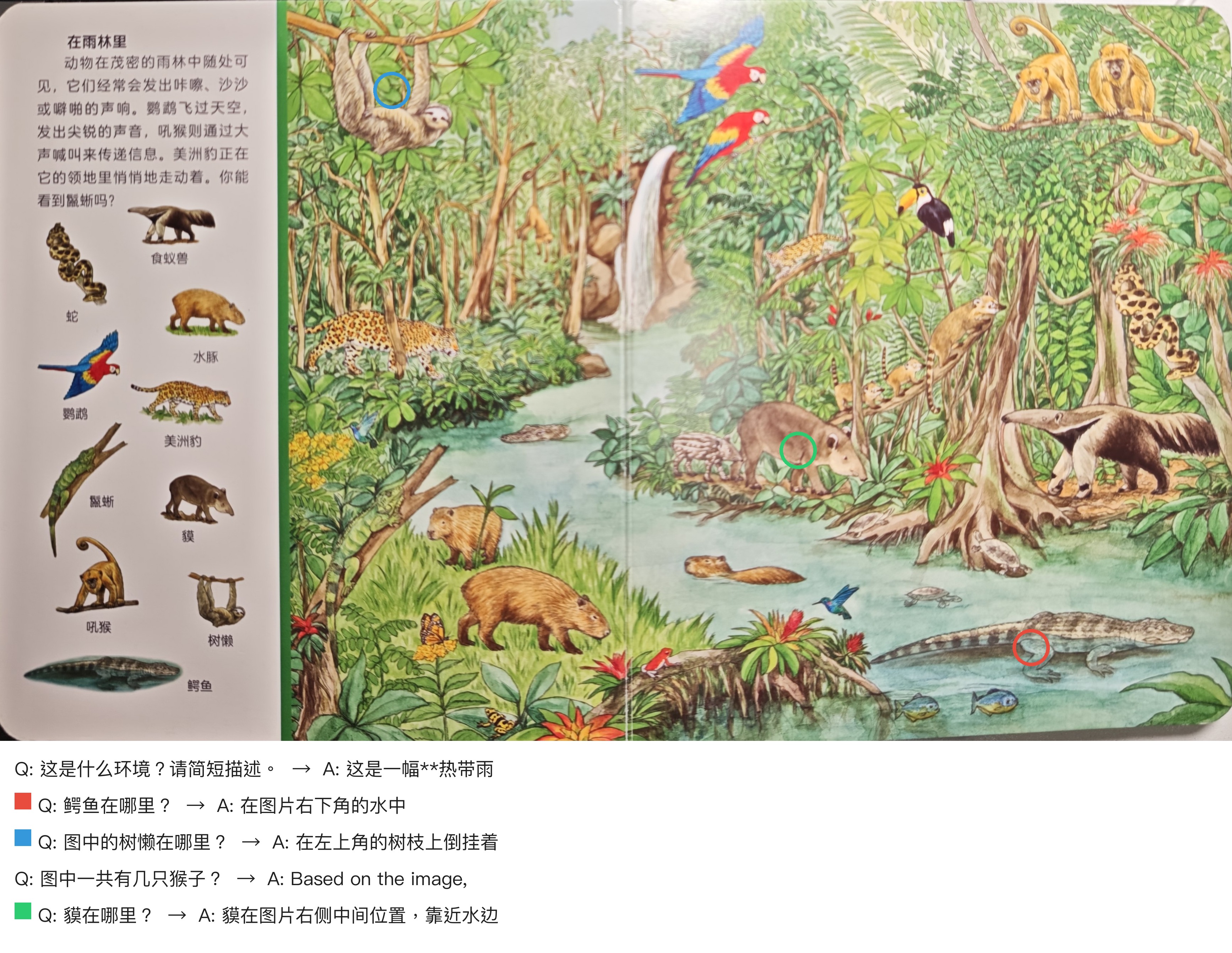
【Rainforest】
Me: Where is this? This is a rainforest, Rainforest. Because it rains often here, the plants grow very densely. There are more trees than in a regular forest, and lots and lots of animals.
Child: There’s a waterfall.
Me: Yes, there’s a waterfall.
【Crocodile】
Child: Where’s the crocodile?
Me: The crocodile is here. The crocodile is hiding underwater with just its head showing, also looking for its prey.
【Sloth and monkeys】
Me: Where are the monkeys?
Child: (points to the location)
Me: This one is a sloth.
Child: Sloth.
Me: That’s not a monkey — it’s called a sloth. Sloths are very lazy; they just stay here without moving.
Me: How many monkeys are there?
Child: (counting) Two monkeys.
Me: Right, there are two monkeys. You’re so smart.
Child: Monkeys have tails.
Me: Monkeys have tails. Do you have a tail?
Child: No.
Me: What about Daddy?
Child: Daddy has no tail.
Me: Daddy has no tail either.
【Tapir】
Me: Where’s the tapir? Here (pointing). The tapir has a baby with it, following right behind.
From these dialogue patterns we can roughly see the differences between teaching a child and teaching a large model:
- The conversation between me and my child is interwoven, with each next question dynamically adjusted based on the child’s answer — keeping difficulty at the boundary of the child’s cognitive level.
- The child is not a passive receiver; he also describes things proactively and even asks me questions — like saying “there’s a waterfall” or asking “where’s the crocodile?”
- While teaching, I also extend the book’s content into daily life with analogies — like asking “monkeys have tails; do you have a tail?” or “does Daddy have a tail?”
Teaching a child is more like a combination of on-policy distillation and curriculum learning. A teacher model gives real-time feedback based on the child’s “output” and generates the next round of training samples. Training a large model, by contrast, is mostly preparing massive static datasets and force-fitting knowledge in.
Could these questions stump today’s SOTA models? Below are GPT-5.5’s VQA and 2D grounding results:
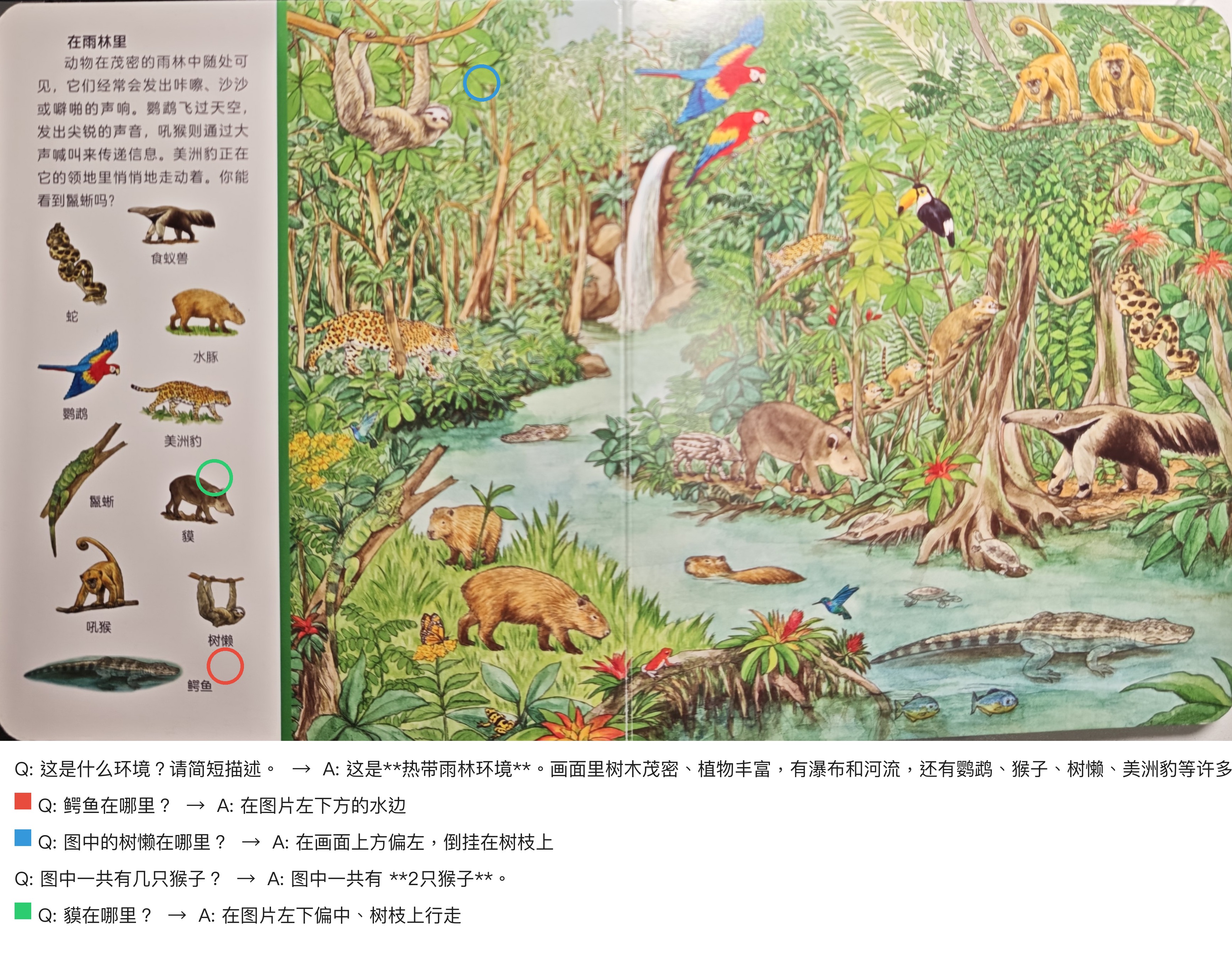
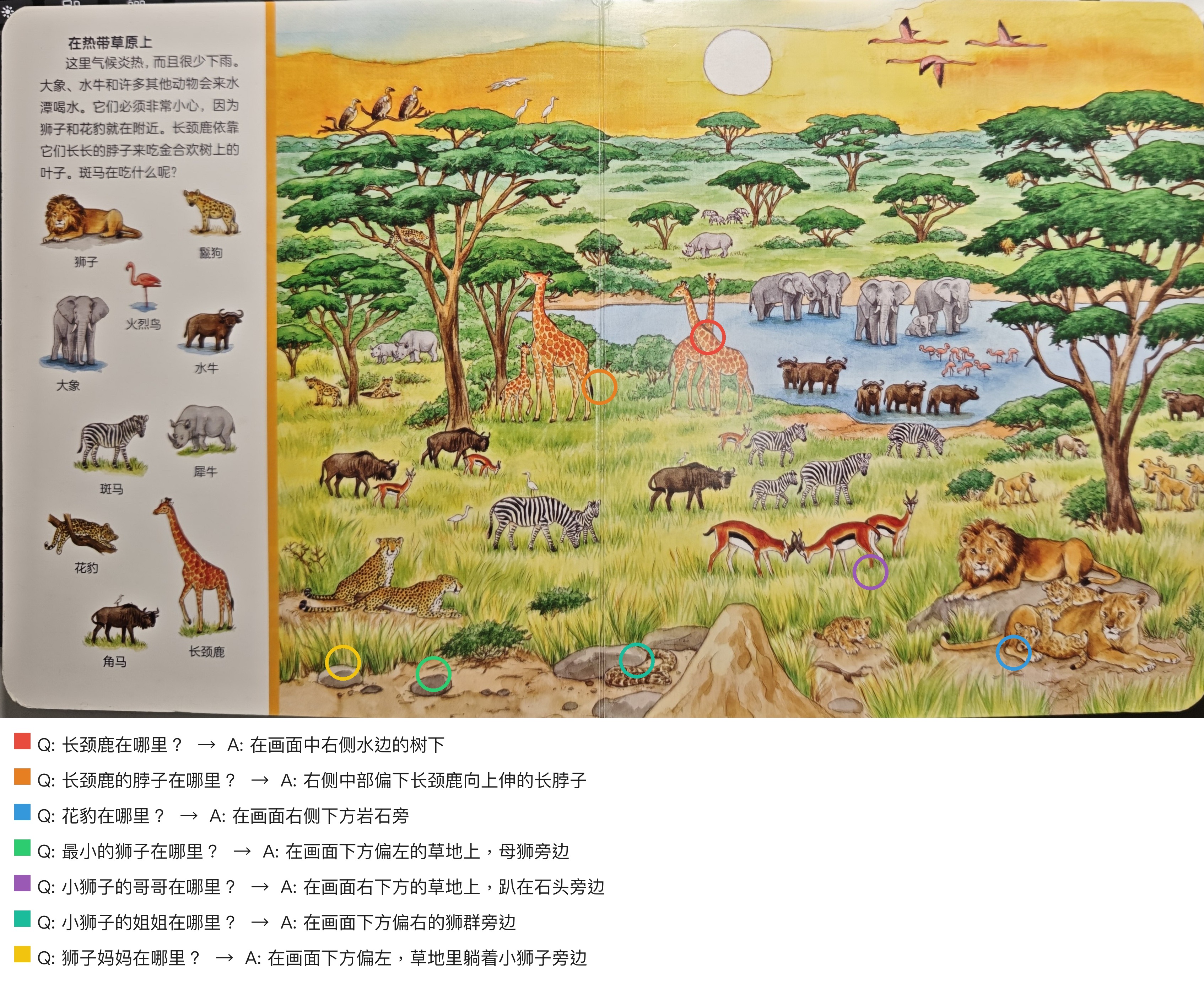
For GPT-5.5, apart from some confusion between lions and leopards, the text descriptions in the VQA are basically correct. But its 2D grounding is rather poor — it can only vaguely gesture at a rough area. The pictures I provided come from a classic children’s picture book that has most likely already entered GPT’s training set, so the good VQA performance was expected. But why the 2D grounding is this bad was not.
I suspected weak 2D grounding is because GPT-5.5 is not natively multimodal, so I tried Gemini-3-Pro and found it much more accurate:
To summarize:
- Although the interaction between my child and me closely resembles the training of an LLM, it cannot be directly converted into training corpora. The stories are tailored to the child’s cognitive level, always sitting at the edge of his cognition, with far sparser information content.
- Based on this picture book, comparing a 2-year-old’s cognitive ability with large models’: Gemini-3-Pro is not weaker than the child, while GPT-5.5’s 2D grounding is comparatively weak.
- I still believe education is the key to “how a human becomes human.” Education in the broad sense is not just book or textual knowledge — these capabilities may be the key to agents integrating into human society in the future. Either we capture the various contexts of a human’s growth process, or we place an “agent baby” into society to go through a complete growth process.
- I remain very interested in this topic; the current conclusions are still too shallow. I hope to have more thoughts as my child grows.