Jun 27, 2026
AI-Coding Project 002: Baby Picture Books
#周报
My spare time over the past month has gone almost entirely into my second AI-coding project — baby picture books.
Compared with the first project, the Panel Discussion, which was just a chat tool built on a whim, I wanted to go further here. Influenced by Guo Yu, I hoped to complete a simple commercial loop open to the public. The purpose of this blog post is to record the story of this project.
Since this project targets parents with young children, and to save some tokens, I won’t post the site link.
Motivation
My child is 2 and loves reading picture books. Understandably so — at this age kids can’t play with phones or watch TV, and picture books open up new worlds for them. Whether it’s Pip and Posy or the Jiujiu Learns to… series, the child always immerses himself in picture books. They also carry the responsibility of broadening horizons and habit education. When my wife and I spend time with our child, we often map his current behavior onto stories from his books — this helps him understand his emotions and what counts as good or bad behavior.
With LLM image generation so advanced, we couldn’t help thinking: if we could use our own child’s likeness to customize our own stories, wouldn’t that better fit his developmental stage, with more fun stories?
Meanwhile, I had seen many AI-customized picture book products on Xiaohongshu. Two typical categories: the My Name series, telling babies through a cartoon story where their name comes from; and the Know Yourself series, where the user uploads a photo of their baby and receives teaching material about eyes, ears, mouth, and nose featuring their own baby as the model. Technically these customized books aren’t complex, but combined with the mother-and-baby market and the personalization angle, they satisfy a large group of consumers.
Against this background, my second project aims to build a tool that serves myself — letting me use my child’s likeness to create my own picture book stories.
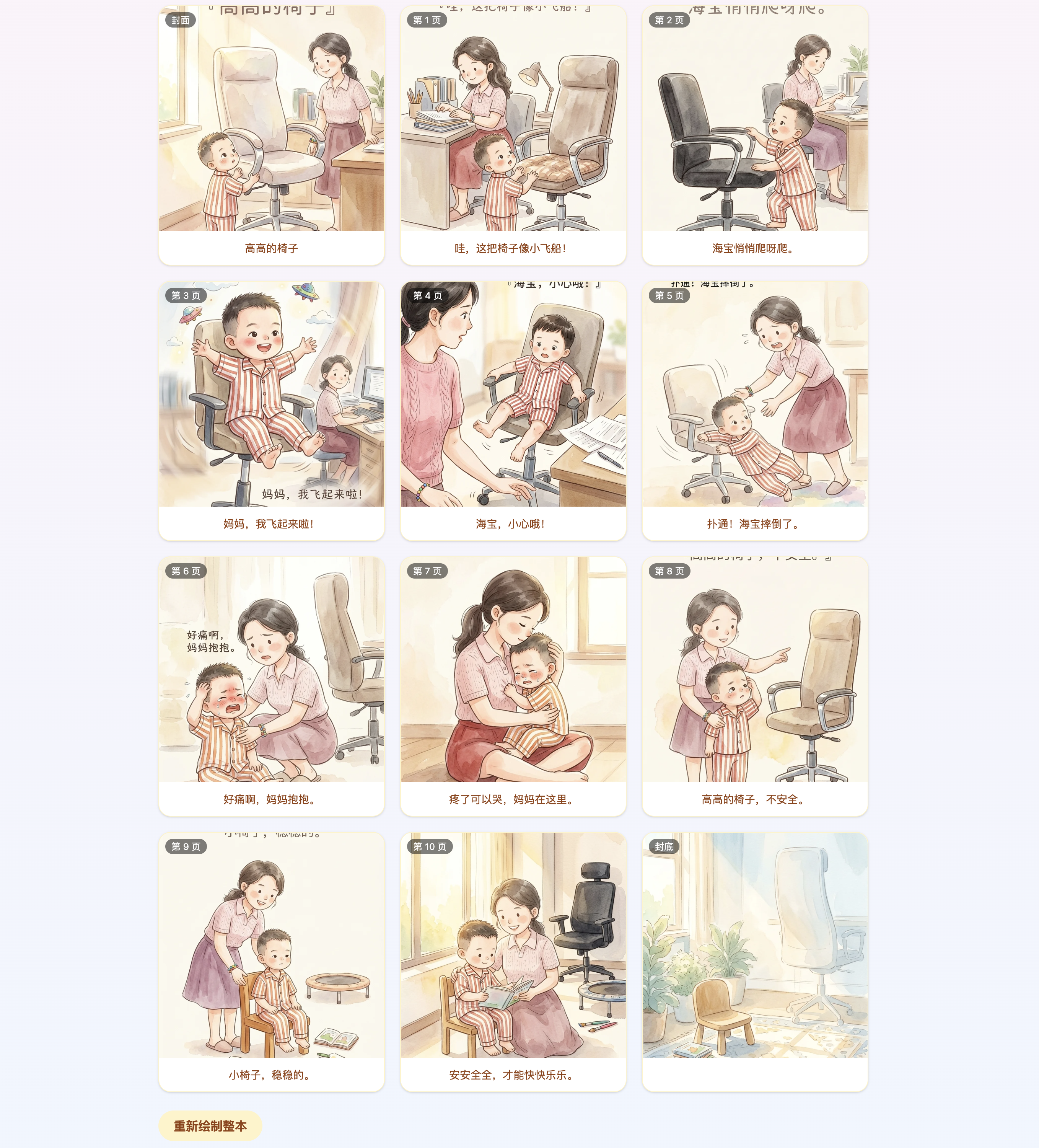
For example, my child especially loves climbing chairs to do acrobatics. One day he fell off and cried his eyes out. Using this as the prototype, we created a story called The Tall Chair, hoping he would learn the lesson (in practice, he didn’t):
Project Details
The core technology is very simple: connect two kinds of models — an LLM (e.g., GPT-5.5 or the domestic Doubao models) and an image editing model (e.g., nano-banana-2 or seedance-2.0). There are just three steps: extract the character likeness from the user’s uploaded photo; use the LLM to generate the story outline and the storyboard for each page; finally, use the image editing model to generate the picture book pages based on the character likeness.
Though the core tech is simple, the details require constant polishing. For example, character consistency: a picture book typically has a dozen or twenty pages, and we want the key characters and objects to stay consistent. This can’t be achieved with a single prompt — it requires providing correct references during generation (context engineering). Second, the storyboard design needs continuous polishing; different types of books have different content needs: story books need plot twists, while nature books focus on knowledge transfer. Finally, LLM calls are unstable — whether image or text models, generation commonly takes 10+ seconds, with occasional call failures, testing the system’s stability.
Beyond the core system, to let the public create their own picture books on the web I also needed a series of work: user login, payment, onboarding, and so on.
Going Live
Getting this website onto the public internet — completing the whole loop of login, usage, and payment — took me more time than polishing the core system. A brief list:
-
The domain and server were bought on Tencent Cloud. After purchasing the domain, you need ICP filing and public-security network filing. Tedious, but Tencent Cloud has fairly detailed guides for both steps.
-
User login needs a verification-code service. Only Alibaba’s SMS authentication service supports individual developers; others, including Tencent Cloud and third-party SMS providers, require a business license. Even Alibaba Cloud only supports phone-number verification for individuals.
-
WeChat Pay. This was slightly easier — after discussing with Doubao there were several viable service providers to choose from. Again, as an individual developer there are some hassles: the intermediary platform takes a cut.
-
LLM services. Alibaba Cloud and Volcano Cloud (Volcengine) both offer LLM APIs, representing China’s highest-level models: the Qwen and Doubao series. Every user has free quota for testing model availability. I suggest every developer pay attention to cloud vendors’ API products — e.g., Volcengine offers multimodal, text, vision (2D, 3D), speech (understanding, generation, music), embeddings, and other model types. Besides online inference, they offer batch inference (cheaper large-scale inference for scenarios not needing real-time responses). These LLM APIs will undoubtedly spawn countless more interesting applications.
Some Decision Considerations
-
Pricing. This is the hardest part of the whole project. First, every generated image has a fixed cost — a picture book of a dozen pages costs a few RMB in API fees. How to price, and when to charge, was what I spent the most time thinking about. I could require users to top up at registration, so I never front any money, but that would turn most users away. The current strategy: new users get a free allowance sufficient to make one book; subsequent creation requires paying for credits.
-
Whether to deliver a physical product. My project supports exporting the picture book as a PDF; hooked up to a Taobao print shop, it could actually be delivered as a physical book. That delivery method surely matches user needs better, and one-time profits would be much higher than the digital version. But for now I chose not to deliver physical books — users who want one can print it themselves on Taobao. My motivation: I don’t want this project to bring me unnecessary trouble; physical printing and shipping can go wrong.
-
Operations. The project isn’t fully launched yet, and how to operate it afterwards is a headache. To break even, the project must reach more users. Buying Xiaohongshu traffic is one option, but it adds cost. An invitation mechanism is another: every user can use an invite code to help spread the word, and activating an code grants credits to both sides. Only paying users bring revenue — if my site suddenly fills with free-riding users, the more users the more I lose.
Summary
The original intent of this project was to fully experience the daily life of an indie developer. With coding agents’ help, I’m confident I can solve any problem. Compared with the picture-book-generation algorithms, the surrounding development (including all kinds of review processes) and decision-making consumed most of my energy.
I hope this experience gives me some accumulation (or lessons), so that in the future I can use large models to create value for more people.