Jul 5, 2026
Observing a Two-Year-Old Through the Lens of LLMs
#周报
Warning: this post mixes a lot of LLM jargon with everyday vocabulary, and is somewhat colloquial.
My son is two years old. I can clearly feel that after turning one, his motor skills, language, and thinking have visibly strengthened, and he often behaves in ways beyond expectation. As someone who works with large models every day, observing a child’s intellectual development is fascinating.
A two-year-old often accompanies what he does with speech output — especially narrating what he sees and what he is doing. While eating, he murmurs “get the spoon,” “eat,” “drink water.” Seeing a high-speed train pass far away, he chatters “train coming~,” “train going~.” It’s fair to say his speech and his thoughts are completely aligned, and when doing things he also aligns his actions within the same space. Kids this age can’t yet be “insincere”: what they say and do is a direct mapping of what’s in their brain. From an LLM perspective, this is a typical early-stage V-L-A example. As the brain develops (trains), most capabilities get internalized into the subconscious (latent space); only complex reasoning needs to be consciously thought through before manifesting in behavior or speech.
Most of a child’s capability acquisition — motor skills, learning abstract concepts — indeed follows the pattern of imitation first, reinforcement later. Since you cannot force a child to do anything, unless the child imitates spontaneously, everything else requires some form of reinforcement learning to teach.
Learning to ride a balance bike (a pedal-less bike) is a typical example. Despite watching many kids ride cleanly, at first he couldn’t ride after mounting — he mostly straddled the bike and walked, or lifted it with his hands and moved together with it. Not really “riding” at all. Walking while carrying the bike is clearly more effortful than walking alone, so initially he didn’t even want to ride. But we encouraged him to watch other kids, and explained that once you can ride you can zip around freely and be first in line for the slide. We told him to put his bottom on the seat and pedal while sitting as much as possible. Gradually, he went from walking with the bike, to sitting on it and walking, to gliding on it. Riding a balance bike must be practiced on-policy by oneself; observation alone can never teach it.
The imitation-plus-reinforcement approach also applies to learning abstract concepts. Imitation learning gives the child the ability to say abstract concepts (with some probability of saying them correctly); reinforcement learning lets him use abstract concepts correctly (raising the probability of saying them correctly). Take learning numbers: you first turn counting into a nursery rhyme to make him familiar, then improve understanding. You count for him everywhere in life — pointing at floor numbers in the elevator, counting “one, two, three” while lifting him high. Eventually the child can count along, but he doesn’t really know what he’s saying. Once he can say it, you can add many tasks to improve understanding — like “how many spoons do you have now?” or “count how many birds are ahead?” Only through this process does he gradually grasp the mapping between numbers and objects.
For a two-year-old, this method still can’t solve learning the concept of personal pronouns (you, me, he). The root cause is that the child’s brain isn’t strong enough to process complex references — the meaning of pronouns is coupled with the speaker’s role. I would encourage him to say “Daddy hug me.” But in other life scenarios, I’d also ask him “do you want a hug?” The concepts of “you” and “me” thus conflict, causing him much confusion — when flustered he says strange things like “Daddy, don’t look at you!” I believe that as his intelligence develops (parameters converge), he will capture the relative nature of pronouns, and the problem will disappear.
From how a child acquires language, we can also see the difference between native and second language learning. Native-language learning starts mostly from imitation and is internalized into the feature space. Second-language learning starts more from grammar and vocabulary, acquiring the language at the logical level — a foreign language is more like tool using.
A child’s analogical ability is remarkably strong. For example, his cognition of animals is actually largely built on analogy. After seeing some giraffes (real ones, animated ones), he can build recognition of many giraffe forms, including all kinds of cartoons. This sample-learning efficiency is far higher than deep learning’s.
Obviously, strong generalization of cognition doesn’t always lead to correct results. Take his understanding of stairs. At one and a half, when going up and down steps, I would tell him “these are stairs.” Sometimes he would walk to a corner where walls meet and say “these are stairs.” That means the child had defined stairs as “folds/angles on buildings,” ignoring the walking function and horizontal steps feature. After pointing out that walls don’t count as stairs (constructing negative-sample boundaries), he never mislabeled stairs again.
A child who just turned two still lacks these abilities:
-
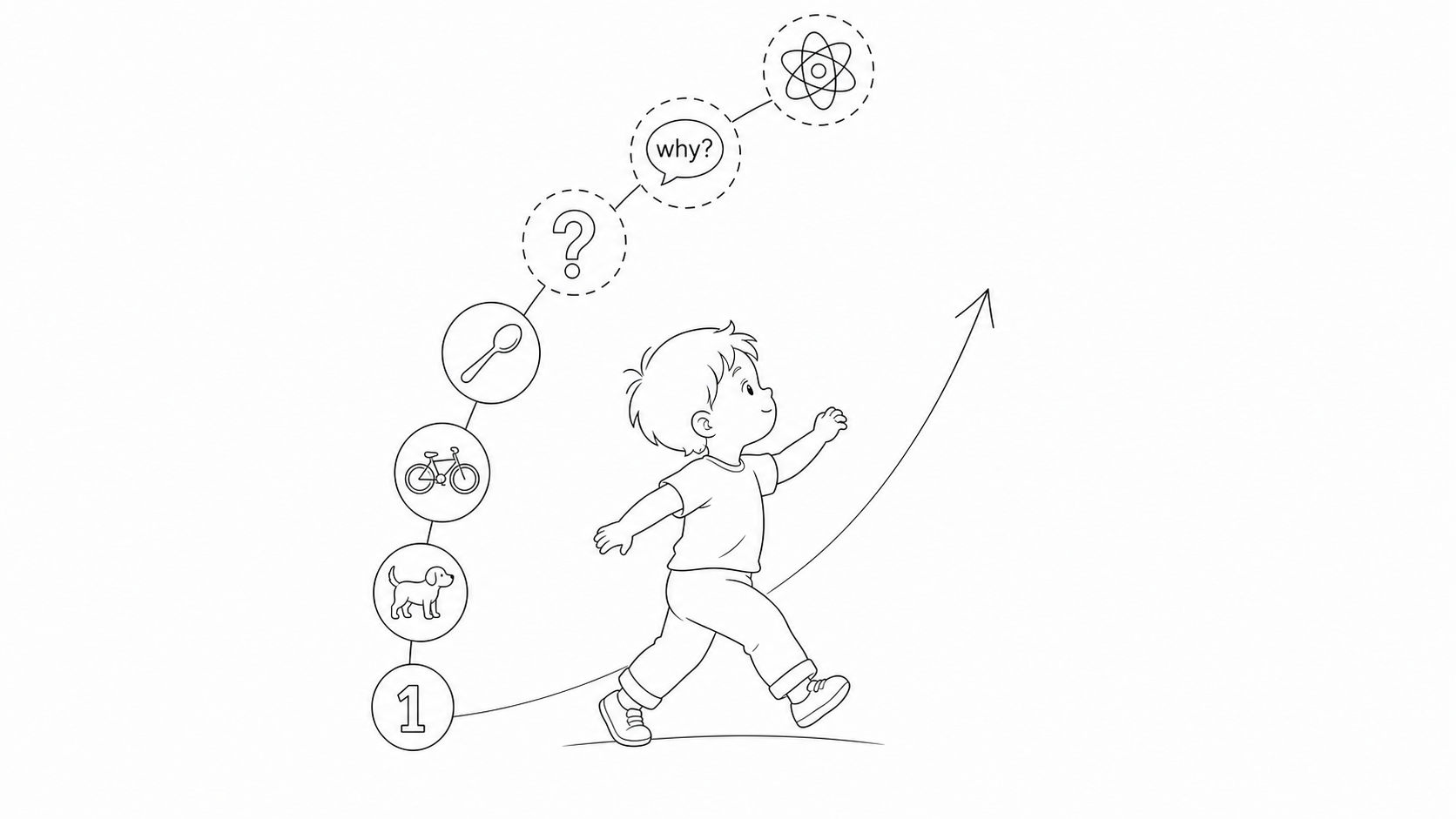
Causal logic understanding. He asks “what’s this?” and “what’s that?” but has never asked “why?” If you ask him a “why” question, all you get is silence or an off-topic answer — he doesn’t understand what “why” means and can only see surface-level things.
-
Insufficient cognition of concepts beyond physical entities. He is interested in visible objects, often asking “what’s this?” and “what’s that?” — focused on objects in the current visual input. He has never asked for the meaning of a concept, like “what is happiness,” or asked us to explain a word from our conversation.
Observing how a child’s abilities grow bit by bit is a fascinating subject. In the time to come, I will keep recording the surprises and inspirations my child brings.