Sep 19, 2026
Reward AI Deep-Dive Research Report
#AI 总结
A cross-embodiment robot foundation model company grown out of the Stanford DexCap / Mobile ALOHA lineage
Website · https://www.rewardai.com/
Primary technical document · OM-1: Frontier Robot Intelligence, Learned Firsthand from Humans (2026-09-14)
About us (signed by the CEO) · https://www.rewardai.com/about/
Official demo video · https://youtu.be/IJvyS2aPsnA | Official X @RewardAI_ | YouTube @reward-ai
00Conclusions First
1. Company profile. Reward AI is a San Francisco Bay Area robot foundation model company founded in 2025 and out of stealth since 2026-09-14, started by two Stanford PhDs: Zipeng Fu (CEO) and Chen Wang (CTO).OfficialCorroborating
2. The thesis in one sentence. Move the data entry point of robot learning from the robot body to the human hand: use a self-built 7-DoF wearable capture device, Omnibody Hand, to record natural human manipulation as multimodal streams; train a cross-embodiment generalist policy, OM-1; then let a high-frequency control layer trained with sim RL absorb the dynamic differences between machines — the official slogan being One Model, One Data Interface, Any Body.Official
3. It is an industrialized upgrade of the UMI → DexCap lineage. UMI's core mechanism was "one handheld gripper — worn by a human to capture, mounted on a robot to run"; Reward AI swaps the gripper for "the same 7-DoF functional hand + tactile/proximity/force + electromagnetic tracking", and explicitly splits out a control layer with its own clock. The CEO is a co-author of UMI on Legs (CoRL 2024); the CTO is first author of DexCap (RSS 2024).Corroborating · provenance
4. The only verifiable hard number today is capture-side tracking error (mean overshoot at high speeds 24.9 mm → 9.5 mm, a 60% reduction). Task success rates, data volume, model parameter count, inference frequency, funding, customer names — all undisclosed.OfficialCorroborating
5. Commercialization hasn't really started, but the direction is written all over it. No pricing, no customers, no API, no open source. The founders repeatedly stress "Efficiency is ROI" and "every clip runs at 1x speed" — explicitly benchmarking against production-line takt time and deployment returns, and stressing that the model can be "dropped onto whatever robots already stand on a customer's floor".OfficialInference
01Company Snapshot
| Item | Content | Type |
|---|---|---|
| Company name | Reward AI (brand and X handle both written "Reward AI"; domain rewardai.com) | Official |
| Founded | 2025 (LinkedIn company page); the two founders completed their Stanford PhDs around 2025 | Official |
| Location | San Francisco Bay Area (per third-party media; no address on the official site) | Corroborating |
| Size | 11–50 people (LinkedIn company page); Privately Held | Official |
| Self-description | "engineers, company builders and researchers … spanning the full stack: from large foundation models to gearboxes, from hands to legs, from visual and tactile perception to high-frequency control" | Official |
| First product | OM-1 (Omnibody Model 1), a generalist robot policy + the full Omnibody stack (Omnibody Hand / One Data Interface / Control Any Body) | Official |
| Funding | Amount, round, and investors all undisclosed. Third-party industry newsletters explicitly note that "as of this launch, the company's website has not disclosed funding amount or investors" | Corroborating |
| Openness | Model weights, code, datasets, and API are all closed; no papers published | Corroborating |
| Contact | general@rewardai.com (business), careers@rewardai.com (hiring) | Official |
02Source Inventory
The research draws on 49 sources in three categories. The table below is the category-level skeleton.
| Category | Count | Representative sources | Role in this report |
|---|---|---|---|
| Official | 15 | Website homepage / About us (CEO-signed) / blog index / OM-1 technical blog post / official demo video / official X @RewardAI_ / official YouTube @reward-ai / LinkedIn company page / Zipeng Fu's launch post / both founders' personal sites and CVs | The factual baseline. Caveat: every performance claim is a "company self-report"; no third-party replication yet |
| Corroborating | 31 | Papers and project pages: DexCap / Mobile ALOHA / HumanPlus / DeepWBC / UMI on Legs / UMI / Sequential Dexterity / MimicPlay / SwingBot; Humanoids Daily, RuntimeWire, Digital CxO, CIVL, humanoid.guide, Tencent News · Qianzhan Robotics, NetEase, SOURCEMIND, alphaXiv, Lacuna | Technology lineage tracing + cross-validation + competitive positioning. Within media coverage, "reported facts" are kept distinct from "author commentary" |
| Inference | 3 | Author lookups behind the 14 images in the About page's "Selected past work by our team"; the judgment on the commercialization path of "closed source + no customers + Efficiency is ROI" | Fills gaps the company hasn't disclosed. Each item shows its reasoning chain and is kept separate from official facts |
The About page carries a section, "Selected past work by our team", rendered as a scrolling image group. Its caption text is invisible on the page, but each image's alt attribute is readable official text — currently the only official clue for inferring "who is on the team besides the two founders". Section 03's team inference rests on this.
Likewise, the aria-labels of the 9 demo videos in the OM-1 post are official text; one reads verbatim: "Omnibody Hands in motion, on robot arms and worn by a person at a table" — official evidence that the same hand is both worn by a person and mounted on a robot.Official
03Core Team: Backgrounds and Signature Strengths
3.1 Zipeng Fu · Co-founder & CEO
- BS
- UCLA, Computer Science + Applied Mathematics double major (2016–2020), advised by Song-Chun Zhu
- MS / research
- CMU master's in Machine Learning + graduate researcher at the Robotics Institute (2020-08–2022-06), advised by Deepak Pathak and Jitendra Malik
- PhD
- Stanford AI Lab CS PhD (from 2022-09), advisor Chelsea Finn, completed in 2.5 years; Pierre and Christine Lamond Fellowship (top 7 in the CS department)
- Industry
- Google DeepMind student researcher (2023-06–2023-12, working with Jie Tan on foundation models for robot navigation); Vayu Robotics internship (2022-07–09)
Official Personal site zipengfu.github.io and CV; Corroborating alphaXiv records add the Vayu Robotics stint
Work during and before the PhD: a complete chain from low-level adaptation to deployable systems
| Representative work | Venue | What it did | Capability built |
|---|---|---|---|
| RMA: Rapid Motor Adaptation | RSS 2021 (during CMU master's) |
Let quadrupeds recover locomotion on unseen terrain via online adaptation; widely covered by WSJ, Forbes, DARPA, and others | Low-level robust control + online adaptation |
| Deep Whole-Body Control | CoRL 2022 Oral · Best Systems Finalist |
One unified policy solving manipulation and locomotion together — whole-body control of a quadruped/wheeled base + arm | Systematizing whole-body control (WBC) |
| Robot Parkour Learning | CoRL 2023 Oral · Best Systems Finalist |
Quadruped parkour: perception-driven agile locomotion over complex terrain | Perception–control tight coupling |
| UMI on Legs | CoRL 2024 | Porting manipulation policies learned with UMI (handheld gripper capture) onto mobile bases through a manipulation-centric whole-body controller | Direct participation in the UMI lineage: understanding how capture–policy–control interlock |
| Mobile ALOHA (co-first author) | CoRL 2024 | Low-cost (~$32k) bimanual mobile manipulation system: stir-frying shrimp, opening cabinets, pressing elevator buttons, rinsing pots; fully open-sourced hardware and software; went globally viral | System-level engineering + large-scale impact |
| HumanPlus (co-first author) | CoRL 2024 Best Paper Finalist (top 6) |
Humanoids learn by "shadowing" human motion from an egocentric view, then imitation learning from human motion | Humanoid embodiment + human-to-robot transfer |
| Mobility VLA / Open X-Embodiment | CoRL 2024 / ICRA 2024 (Best Paper) | Navigation foundation model; cross-embodiment dataset and RT-X models (a DeepMind-led collaboration) | Foundation-model paradigm + cross-embodiment data standards |
His core skill is not "inventing new algorithms" but "actually deploying learned policies in the open world." From RMA (controllers that don't fall apart on unseen terrain), DeepWBC (locomotion and manipulation fused into one policy), Robot Parkour (perception–control coupling pushed to the limit), to Mobile ALOHA / HumanPlus (reproducible, open-sourceable, demonstrable complete systems) — every step along this line answers the same question: how to keep a learned policy from failing on real machines at real tempo.
This directly explains OM-1's architecture choices: why the control layer is a first-class citizen — an independent high-frequency clock, sim-RL training, online optimization of transitions between adjacent predictions. That is not what someone who builds VLAs would design first; it is exactly what someone who has spent four years on "deployable robot systems" would design first.Inference (based on the consistency between his paper sequence and OM-1's architecture)
A secondary but key point: he is a co-author of UMI on Legs, with first-hand experience of UMI's route of dissolving the embodiment gap using the same handheld hardware. That explains why Reward AI dares to make "the same Omnibody Hand worn by humans and mounted on robots" its cross-embodiment mechanism.Corroborating
3.2 Chen Wang · Co-founder & CTO
- BS
- Shanghai Jiao Tong University, Computer Science, advised by Cewu Lu
- PhD
- Stanford CS PhD (from 2020, graduated 2025-06), advised by Fei-Fei Li and C. Karen Liu
- Research stints
- MIT CSAIL (2019, Edward Adelson's GelSight group) → NVIDIA Research (2022, NVIDIA Graduate Fellowship Finalist) → Google DeepMind (2024)
- Self-described focus
- "robot learning for dexterous manipulation, imitation learning from human motion, and long-horizon planning and control"
Official Personal site chenwangjeremy.net
Work during and before the PhD: a relentlessly focused human-motion → robot-motion line
| Representative work | Venue | What it did | Capability built |
|---|---|---|---|
| DenseFusion / 6-PACK / force-torque dynamics | CVPR 2019 ICRA 2020 IROS 2019 |
6D object pose estimation (RGB-D dense fusion, category-level keypoint tracking); transferable force-torque dynamics models for peg-in-hole | Modeling contact and force (already during undergrad) |
| SwingBot | IROS 2020 Best Paper Award |
Learning object physical properties through in-hand tactile exploration for dynamic swinging manipulation (MIT GelSight group) | Tactile-driven dynamic manipulation |
| Co-GAIL / HAN / robomimic | CoRL 2021 IROS 2021 |
Extracting collaboration policies from human–human collaborative demonstrations; a hand-eye-coordinated action space; the robomimic large-scale imitation-learning benchmark | Imitation-learning infrastructure |
| MimicPlay (first author) | CoRL 2023 Oral · three finalist nods |
Extracting latent plans from videos of humans freely playing to guide low-level robot policies, sharply reducing dependence on robot teleoperation | Trading cheap human data for expensive robot data |
| Sequential Dexterity (co-first) | CoRL 2023 | "Chaining" multiple multi-finger policies for long-horizon manipulation; switching functional modes without regrasping | Multi-finger dexterity + long-horizon composition |
| VoxPoser / ReKep / TRANSIC / Obj-Dex | CoRL 2023–2024 | LLM-synthesized 3D value maps; relational keypoint constraints for spatio-temporal reasoning; sim2real online correction; object-centric dexterous manipulation from human motion data | High-level planning + on-robot correction |
| DexCap (first author) | RSS 2024 | Portable hand mocap system: chest camera rig (RGB-D LiDAR + 3 SLAM cameras) + electromagnetic-field mocap gloves + backpack compute/power (~40 min); capture human dexterous manipulation → fingertip-IK retargeting onto the LEAP hand → point-cloud Diffusion Policy | The direct predecessor of Omnibody Hand |
His entire PhD did one thing: lowering the conversion cost from human demonstration to robot execution. Co-GAIL (learning from human–human demos) → MimicPlay (latent plans from videos of humans playing) → Sequential Dexterity (chaining multi-finger policies) → DexCap (portable hardware capturing human hands directly) → Obj-Dex (object-centric dexterous manipulation trained directly on human motion data). No step along this line was incidental; every step thinned the same bottleneck.
The second strength is completeness on the sensing side: he did purely tactile-driven manipulation at MIT's GelSight group (SwingBot, IROS 2020 best paper) and force-torque dynamics modeling as an undergrad. The multimodal combination on Omnibody Hand — tactile + inter-finger proximity + force + in-hand camera — is essentially his technical résumé turned into hardware.Inference
Phrase evidence: the official blog explicitly writes "Building on our prior work DexCap …"; the founder's launch post likewise says "We build on our prior work DexCap at Stanford."Official
3.3 Team beyond the founders: inference from the official past-work gallery
The official site has no team page; the LinkedIn company page shows only one named member, Zipeng Fu, plus five anonymous avatars. The About page's "Selected past work by our team" — 14 images — is the only official clue. Cross-checking each image's alt text against the papers/projects yields the table below. Except for rows marked Official/Corroborating, all person identifications are inference.
| Gallery image (official alt summary) | Corresponding work | Known authors | Type |
|---|---|---|---|
| Bimanual robot stir-frying shrimp at a stove | Mobile ALOHA (CoRL 2024) | Zipeng Fu (co-first) | Official |
| Humanoid folding a hoodie / tying shoelaces | HumanPlus (CoRL 2024) | Zipeng Fu (co-first) | Official |
| Two dexterous hands cutting tape with scissors | DexCap (RSS 2024) | Chen Wang (first author) | Official |
| Robot hand assembling building blocks | Sequential Dexterity (CoRL 2023) | Chen Wang (co-first) | Official |
| Arm operating an espresso machine | VIOLA (CoRL 2022) | Yifeng Zhu et al. (UT Austin) | Inference |
| Gripper fitted with domed optical tactile fingertips | DenseTact (ICRA 2022) | Won Kyung Do, Monroe Kennedy III (Stanford ARMLab) | Inference |
| Quadruped + arm crouching on grass | Deep Whole-Body Control (CoRL 2022) | Zipeng Fu (co-first) | Official |
| Small humanoid climbing wooden stairs | ToddlerBot (arXiv 2502.00893) | Haochen Shi, Weizhuo Wang (both also DexCap co-authors) | Inference (high confidence) |
| Science Robotics cover: quadruped crossing a fallen log | Representative legged-locomotion work | Most likely Robot Parkour Learning (Zipeng Fu co-first) | Corroborating |
| Mobile manipulator picking an apple off a table | GDM / Meta robotics work | A member with big-tech robotics research background | Inference |
| Falcon 9 dual-booster synchronized landing | Aerospace engineering background | Hardware/engineering member likely with SpaceX experience | Inference |
| Cutaway of a 3D-printed cycloidal gear reducer | In-house drivetrain | Mechanical/hardware engineering member | Inference |
From the About page: "We are engineers, builders and researchers who pioneered robot learning in dexterous manipulation, mobile manipulation, and legged locomotion, spanning the full stack: from large foundation models to gearboxes, from hands to legs, from visual and tactile perception to high-frequency control."Official
That is, the company claims simultaneous coverage of: foundation models — gearboxes (hardware drivetrain) — hands (dexterous manipulation) — legs (legged locomotion) — visual and tactile perception — high-frequency control. This mutually corroborates the VIOLA / DenseTact / ToddlerBot / cycloidal reducer / Falcon 9 identifications above.Inference
04Technology: The Integrated Hardware–Software Omnibody Stack
4.1 The architecture at a glance
4.2 Data capture: Omnibody Hand
Hardware trade-offs: functional dexterity ≠ joint-by-joint human mimicry
The company explicitly rejects two paths: the "fragile 20+ DoF joint-by-joint replica of the human hand", and the "parallel-jaw gripper". Omnibody Hand takes the middle: a compact 7-DoF design that keeps only the functions that truly matter for manipulation.
| Design element | Official wording |
|---|---|
| Fine pinch | Captures thumb–index pinches while recording both thumb and index flexion, so the thumb can work with the index as well as with the remaining fingers |
| Power grasp | Middle, ring, and pinky fingers are coupled at the MCP joints, working with thumb flexion to wrap around objects |
| In-hand reorientation | Adjusting an object's pose inside the hand (in-hand reorientation) is listed as one of the three design priorities |
| Ergonomic invariance | An integrated distal flexion mechanism absorbs finger-length differences, lowering sensitivity to joint alignment and eliminating per-user linkage adjustment. Official rationale: discomfort makes people change their grasp style, and "a compensated grasp is no longer the behavior we want to record" |
| Sensing channels | Global-shutter in-hand camera (images), high-frequency tactile, inter-finger proximity sensing, force, hand pose trajectory |
| Tracking scheme | Visual-inertial augmented with electromagnetic (EM) sensing, plus algorithms compensating for environmental EM disturbance |
The only public quantitative benchmark
Positioning in the UMI lineage: the section you've been waiting for
Reward AI never says "UMI" in its official materials, but from hardware to action representation to latency handling, Omnibody Hand is an iteration of the same design paradigm. The table below puts the three generations side by side.
| Dimension | UMI (RSS 2024) | DexCap (RSS 2024) | Omnibody Hand (2026) |
|---|---|---|---|
| Form factor | 3D-printed handheld parallel-jaw gripper + GoPro | Chest camera rig (RGB-D LiDAR + 3 SLAM cameras) + EM mocap gloves + backpack power | 7-DoF wearable functional hand (integrated) |
| End-effector DoF | 2-DoF gripper (opening width only) | Finger 3D positions (relative to palm, EMF-measured) | 7 DoF: independent thumb/index flexion + coupled MCP joints of middle/ring/pinky |
| Tracking | GoPro + IMU-aware SLAM (modified ORB-SLAM3) | SLAM cameras + electromagnetic field | Visual-inertial + EM + compensation for environmental EM disturbance |
| Vision | 155° fisheye + side mirrors for "implicit stereo" | Chest-mounted RGB-D | Global-shutter in-hand camera (keeps visual context during fast motion) |
| Contact / force | None (gripper-width proprioception only) | None (position only) | Tactile + inter-finger proximity + force |
| Action representation | Relative trajectories (relative to the current gripper pose) | Fingertip IK → 16-D joint positions of the LEAP hand | Motion direction / speed / force / event timing (embodiment-agnostic) |
| Cross-embodiment mechanism | Requires "parallel-jaw stroke > 85 mm"; calibration-free | Fingertip-IK retargeting per target hand; FK-generated robot-hand point clouds added to observations to bridge the visual gap | No data-level retargeting; left to the sim-RL control layer to absorb |
| Capture efficiency | ~3× teleoperation | ~3× teleoperation, near natural human speed | Undisclosed (but at natural human tempo, no slowdown required) |
| Signature demo | Dynamic tossing 87.5%, dish washing 70%, in-the-wild generalization 71.7% | New tasks from 30 min of human mocap, no teleoperation | Long-horizon new tasks with challenging dynamics learned in <30 min |
Inherited (5 items):
- The same hardware — worn by a human to capture, mounted on a robot to run. This one has direct official evidence — the OM-1 post's video
aria-labelreads: "Omnibody Hands in motion, on robot arms and worn by a person at a table", plus "An Omnibody Hand on a robot arm unscrewing a braided hose fitting" and "Two robot arms with Omnibody Hands gripping either side of a cable connector".Official - Portable, in-the-wild, capture without robots.
- A hand/wrist camera as the observation center (UMI: wrist-mounted GoPro; Omnibody: in-hand global-shutter camera).
- An embodiment-agnostic "relative / functional" action representation.
- Explicit latency handling (UMI: inference-time latency matching; Reward: upgraded to an independent-clock control layer).
Changed (4 items — also Reward's claimed differentiators):
- Parallel gripper → 7-DoF functional hand. The company pointedly describes the weakness of gripper-style schemes: "parallel-jaw grippers can solve many tasks, but usually by constraining approach direction, contact location, and manipulation strategy". Humanoids Daily echoes: 2-DoF grippers "artificially limit approach angles and contact points".OfficialCorroborating
- Pure-visual SLAM → visual-inertial + EM. Rationale: visual update rates limit the ability to follow fast reversals, and the usual fixes — post-hoc trajectory smoothing or asking people to slow down — both break the goal of capturing fast reaches and fine corrections.Official
- Adding tactile / proximity / force. Filling in the layer of physical information pure vision cannot infer: contact, force, timing.
- Latency handling upgraded from "alignment" to "decoupling". UMI matches observation–action latency at inference; Reward runs the control layer on its own high-frequency clock and optimizes transitions between adjacent predictions online, so jitter in inference latency never interrupts motion.
Provenance: Zipeng Fu is a co-author of UMI on Legs (CoRL 2024) and Chen Wang is first author of DexCap — the two founders stand on the UMI branch and the DexCap branch respectively; Omnibody Hand is where the two lines merge.Corroborating · provenance
4.3 Data labeling: officially, "no labeling needed at all"
This is OM-1's sharpest departure from the mainstream — worth unpacking.
| Labeling step | Conventional approach | OM-1's approach | Type |
|---|---|---|---|
| Action labels | Teleoperated capture → record robot joint/end-effector state → must be aligned to each body's action space | Labels are sensor-endogenous: pose trajectories (tracking), contact and proximity (tactile/proximity sensing), force (force sensing), event timing (grasp/release, judged from contact + force signals) | Official |
| Action retargeting | DexCap needs fingertip IK to map human hands onto the LEAP hand; UMI filters by each body's gripper stroke | The company claims no data-level retargeting: OM-1 generates robot actions directly from human motion, leaving body differences to the control layer | Official |
| Visual domain adaptation | DexCap overlays FK-generated robot-hand point clouds into observations to bridge the human–robot visual gap | No similar mechanism disclosed (presumably bypassed by "the same Omnibody Hand is also mounted on the robot") | Inference |
| Data bucketing | Pre-training / post-training stages, each potentially requiring different labels and filtering | No boundary: all demonstrations enter through the same interface in the same format — "the first demo and the latest demo train the same policy" | Official |
| Scene organization | Staged lab scenes, supervised capture | Official: no staged setup, no supervision — "work, play, cook, or just live your day" all produce data | Official |
| Quality correction | DexCap offers human-in-the-loop correction (residual correction, etc.) | Not mentioned; replaced by emergent retry/compensate/stop behaviors | Corroborating |
Officially, labeling is described as zero-cost. In engineering terms it has more likely been moved to two other places — and neither is disclosed:Inference
- On the capture-device side: spatio-temporal calibration across sensors, consistency across wearers, compensation for environmental EM disturbance — the hidden costs of One Data Interface, and the reason Omnibody Hand had to be built in-house.
- On the control-layer side: to "drop zero-shot onto any body", each target body needs a good-enough dynamics model and domain randomization, plus an RL controller trained in simulation. Every new body still costs engineering — the work has merely changed from "re-capture data + re-train the policy" to "train a control layer".
In other words: Reward moved cost from "data-side, growing linearly with tasks" to "hardware-side, a one-time investment + control-side, growing with the number of body types". Whether that trade pays off depends on how many bodies they can cover — precisely where no numbers are visible today.
4.4 The OM-1 model and the control layer
| Module | Public technical points | Type |
|---|---|---|
| Input modalities | Images (scene context), tactile signals (contact and slip), inter-finger proximity (pre-contact state), hand pose trajectory; and it consumes the temporal history of these streams | Official |
| Sampling-rate handling | Each sensor is processed at its native sampling rate, not downsampled to the camera frame rate — preserving high-frequency tactile and motion cues | Official |
| Action outputs | Motion direction, speed, force, and the timing of key events (grasp/move) | Official |
| Training paradigm | Single stage; no pre-training/post-training split; scaling by "adding human data" rather than "designing a new training phase per robot" | Official |
| Architecture | "A new architecture tailored for efficient inference" (no details disclosed: parameter count, backbone, whether Transformer/Diffusion — all unstated) | Official |
| Control layer | RL trained in simulation; handles velocity/acceleration-dependent dynamics, external disturbances, system latency; independent high-frequency clock; optimizes transitions between adjacent predictions online | Official |
| Coverage | Beyond table-top manipulation: whole-body work (bracing, leaning, stepping into tasks) and navigation for mobile robots | Official |
| Efficiency claims | New tasks learned from <30 min of human demonstration data (incl. challenging dynamics, long-horizon); long-horizon task execution in <30 s (1× speed) | Official |
| Emergent behaviors | When one arm errs the other compensates automatically; knows when to retry; adapts to adversarial perturbations; stops proactively when the environment changes too much | Official |
4.5 Public milestones: the demo list
As of 2026-09-19, the company has published 9 demo videos (embedded in the OM-1 post, 720p/60fps, all watermarked top-left with the official "Fully autonomous, 1x speed") plus one launch compilation. Task names below come directly from official aria-labels and video filenames. Each task carries a GIF preview (transcoded from the official mp4).
Reading the 9 official mp4 files directly yields their true durations: shortest 9.9 s (cross-embodiment), longest 158.6 s (iphone-long). laundry's original is 16.5 s, matching the official copy of "about 17 seconds" — which suggests video length ≈ single-task duration. From this follows an observation the company has not stated: the official line is "long-horizon tasks execute in <30 s (1× speed)", yet ethernet-unplug (107.8 s) and iphone-long (158.6 s) far exceed 30 s — both must contain multiple retries or consecutive multi-cycle runs rather than a single task.Inference
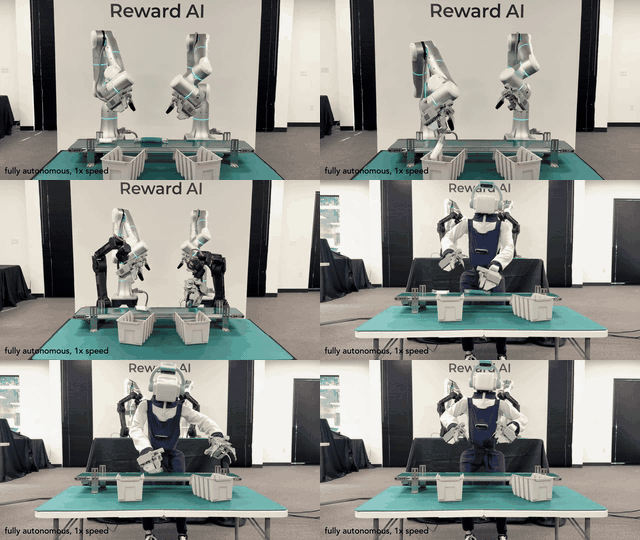
A humanoid and a pair of industrial arms, both wearing Omnibody Hands, sort items off a conveyor into bins under the same policy.
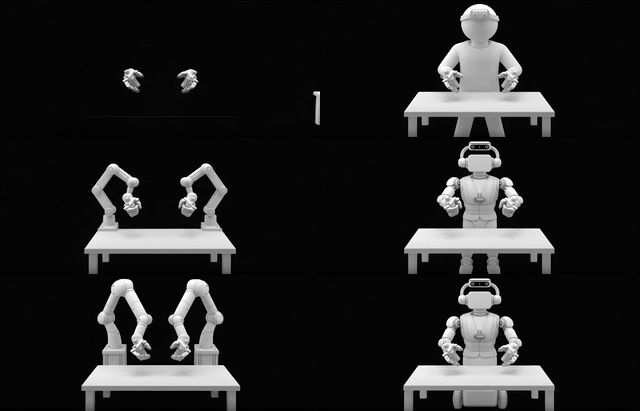
Omnibody Hand in motion — the same hand mounted on a robot arm and worn by a demonstrator. The most direct visual evidence of the "wear it to capture, mount it to execute" isomorphism.
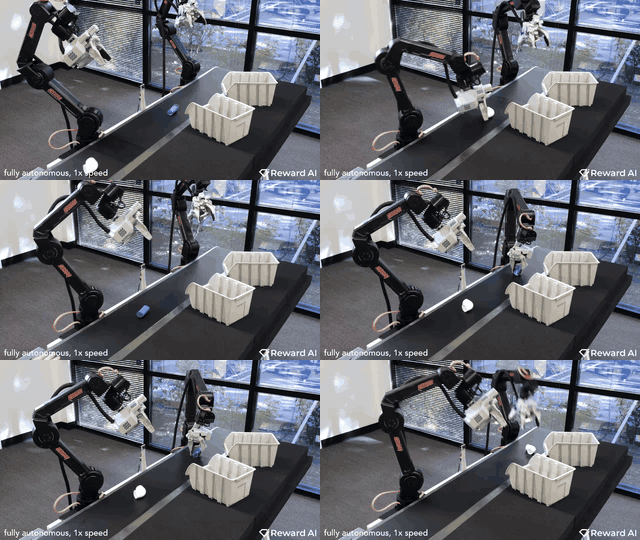
Two arms pick objects off a moving conveyor and toss them into bins.
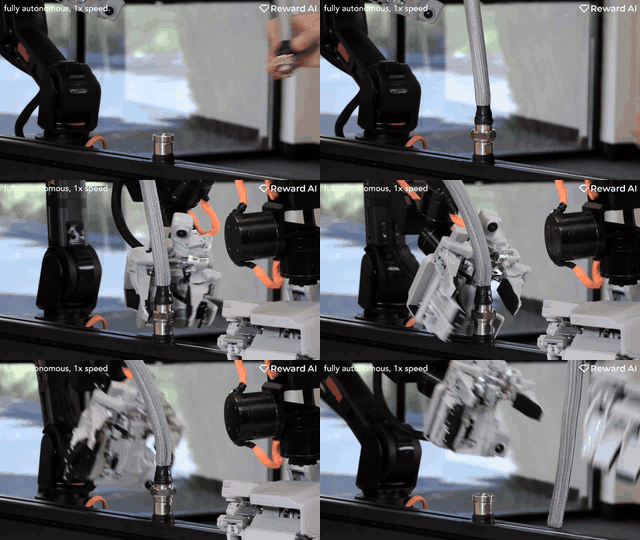
An Omnibody Hand mounted on an arm unscrews a braided hose fitting above a conveyor while the other arm steadies the assembly.
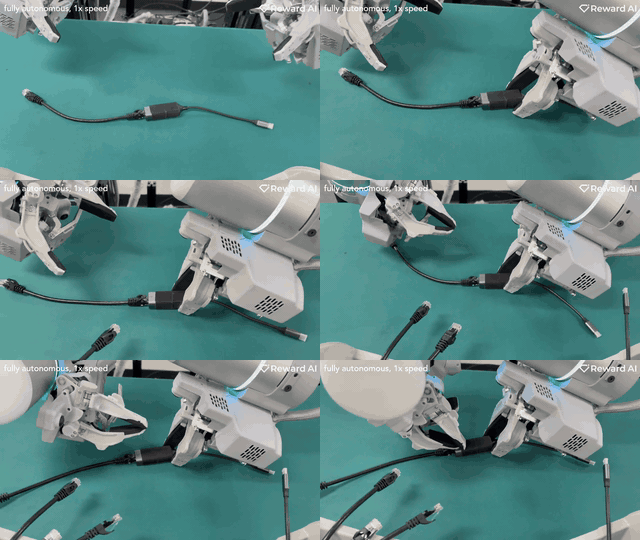
Two arms grasp both sides of a connector with Omnibody Hands and pull it apart; the latch must be pressed with extreme precision to release. Named "deceptively hard" by the founder.
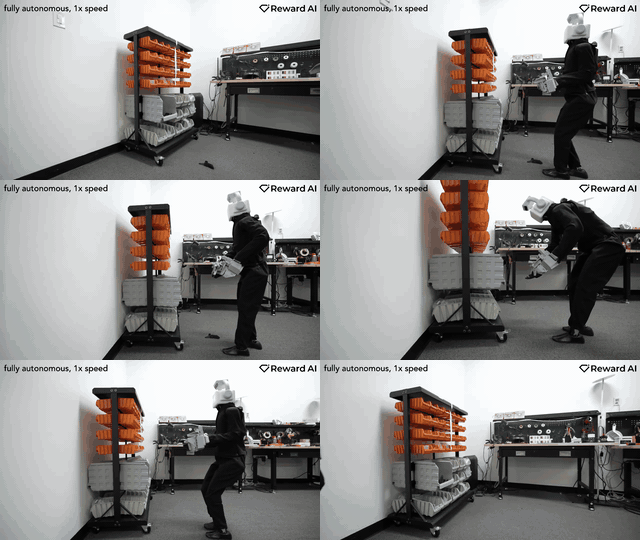
A humanoid picks an item off a rack and tosses it aside.
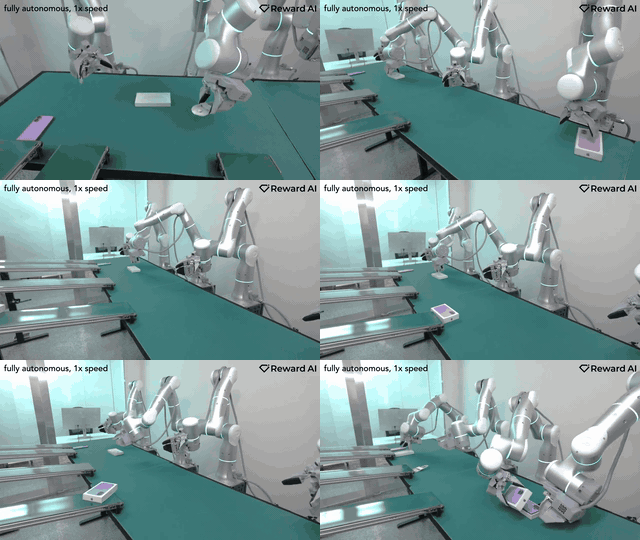
A long-horizon phone-packaging task; the launch video shows four-arm cooperation (quadmanual). The longest of the 9 demos.
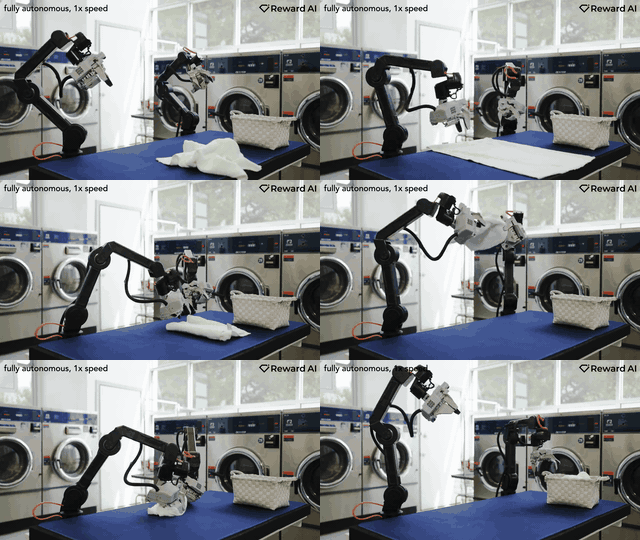
Two arms fold a bed sheet at a laundromat. The original's 16.5 s matches the official copy of "about 17 seconds" — the only demo whose duration can be cross-checked.
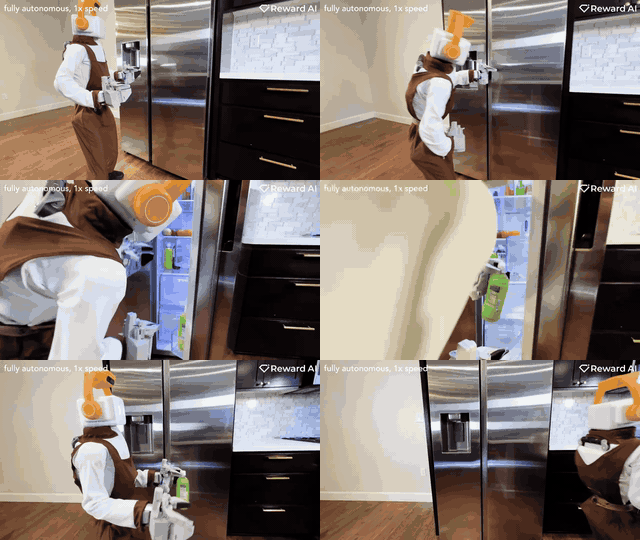
A humanoid opens a fully closed stainless-steel fridge door and reaches in for a drink.
Pouring, adding ice, shaking the tin, pulling the cork, pouring into the glass — in one go. The clip appears in the official launch video; the blog post provides no standalone mp4, hence no GIF.
- Source: all taken from the official mp4 direct links in the blog post (
/blog/OM-1/videos/*-720-h264-labeled.mp4), with no cropping or speed changes. - Transcode: ffmpeg downsampled to 320 px width, 96 colors, 4.5–7 fps. The GIFs are therefore choppier than the originals — this is not the official frame rate; the originals are 60 fps.
- Excerpts:
sorting-2,ethernet-unplug, andiphone-longhave long originals (26 s / 107.8 s / 158.6 s), so their GIFs are uniformly sampled multi-segment splices, not continuous playback. The other 6 are full-length. - Fidelity: the GIFs retain the originals' watermark and "labeled" overlay — first-hand evidence for the official "1× speed" claim.
- Size: the 9 GIFs total about 12 MB, 0.7–1.8 MB each, all lazy-loaded; every file is < 2 MB — small enough for WeChat official-account GIFs (10 MB cap).
- Original mp4s and official video: all 9 mp4s retained locally; the full launch compilation is on the official YouTube video.
4.6 Timeline
05Commercialization: Strategy and Status
5.1 Status: confirmed facts
| Dimension | Status | Type |
|---|---|---|
| Funding | Entirely undisclosed — no amount, round, or investors. Third-party industry newsletters explicitly note that "as of this launch, Reward's website has not disclosed funding amount or investors" | Corroborating |
| Customers / deployments | No customer names, deployment counts, or pilots disclosed | Corroborating |
| Pricing / timeline | No commercialization timeline, no pricing | Corroborating |
| Openness strategy | Model weights, code, datasets, and API all kept in-house; no papers published; the official citation format is "blog article" | Corroborating |
| Team size | 11–50 people; the hiring address careers@rewardai.com sits in a prominent spot on the site | Official |
| Body partnerships | No hardware makers named in public materials. One unverified third-party lead points to a Flexiv Rizon arm participating in demos — could not be double-checked | Inference · unverified |
5.2 Strategic signals: reading between the official lines
| Official wording (verbatim) | Reading | Type |
|---|---|---|
| "Efficiency is ROI. ROI is what gets robots deployed." | Defines "efficiency" directly as return on investment. This is not a researcher's phrasing — it is phrasing for selling to factories | Official |
| "If other models look faster, check the corner of the frame: 2x, sometimes 5x." | Proactively raises the "speed faking" issue and turns 1× speed into a brand asset. Aggressive positioning | Official |
| "Every clip we publish runs at 1x speed, clearly labeled." | Same theme, written into the About page's methodology section — not improvised PR talk | Official |
| "can be dropped onto whatever robots already stand on a customer's floor" | They don't sell robots. The target customer is the factory / integrator that already bought robots — upgrading installed equipment rather than selling new hardware | Official |
| "A robot earns its place in a factory, a kitchen, or a warehouse …" | Target scenes: factories, kitchens, warehouses. Consistent with the demo tasks (3C packaging, conveyor sorting, laundry folding, bartending) | Official |
| "beginning with quadmanual manipulation … extending to mixed teams" | Multi-robot cooperation as the differentiation narrative: aiming at work a single arm can't do (moving furniture, large-assembly, peak-hour kitchens) | Official |
| "demonstrations we collect today will still be training robot bodies that haven't been designed yet" | Data-as-asset: data doesn't depreciate with hardware generations — it appreciates. A dual narrative aimed at investors and customers alike | Official |
5.3 Inferred commercialization path
Most likely path: B2B — deploying/licensing "policy + control layer" to customers that already operate robot fleets, possibly renting or selling Omnibody Hand capture devices for on-site task-data collection. The reasoning chain:
- Closed source, no API → rules out the "community standard / ecosystem platform" route; value capture must happen at the delivery step.
- "Drop onto whatever robots already stand on a customer's floor" → explicitly no robot-making, so revenue cannot come from complete hardware units — only from software capability + capture devices.
- "Efficiency is ROI" + repeated emphasis on takt time → the selling point is hourly output replacing human labor; pricing is likely per deployed site / per robot, not per token or per API call.
- Hiring address pinned + 11–50 headcount + just out of stealth → in a "build delivery capability" phase rather than a "build sales network" phase; near-term, a few deep pilots are more likely than a broad rollout.
Core moat: not the model itself, but the closed loop of "capture device — data interface — control layer". Remove any one link and cross-embodiment degrades into an ordinary VLA. Which also means: their moat depends heavily on the manufacturability and cost of Omnibody Hand — precisely the thinnest part of the public record.
5.4 Competitive landscape
| Route | Representative companies | Data entry point | Type |
|---|---|---|---|
| Wearable human-hand capture (Reward's route) |
Reward AI | 7-DoF functional hand + tactile/proximity/force + EM tracking; a functional middle path — more expressive than 2-DoF, more decoupled than 20+ DoF isomorphism | OfficialCorroborating |
| Same route · closest competitor | Sunday Robotics (Tony Zhao + Cheng Chi) |
Skill Capture Glove: a simpler 2-DoF parallel-jaw design; emphasizes the geometric and sensor correspondence between the glove and their in-house Memo robot hand; focused on chores (laundry folding) | Corroborating |
| Strict isomorphism route | X Square Robot (Shenzhen) | TwinDEX: a 9-DoF exoskeleton that eliminates the embodiment gap through strict physical isomorphism with the matching three-finger robot hand | Corroborating |
| Internet-video pretraining | Dyna Robotics (Dyna-2) Rhoda AI (DVA) |
Massive web/human-video pretraining + task-data post-training. Rhoda reports its largest model completing tasks unassisted within 100 s at 84.7% | Corroborating |
| VLA / foundation models | Physical Intelligence (π0) Gemini Robotics 1.5 / 2 Skild AI (S1), Generalist (GEN-1.5) |
Open robot datasets + teleoperation + synthetic data mixes. Gemini Robotics 2 claims adaptation to a new bimanual robot with a few hours and usually <200 samples | Corroborating |
| Data infrastructure | XDOF (GELLO lineage), Mecka AI | Capture/cleaning/labeling/QC outsourced as a service; XDOF disclosed $70M in funding in June and open-sourced ABC-130K (130k bimanual trajectories / 195 task classes) | Corroborating |
06Key Risks and Watchlist
- Every performance metric is company self-tested. The only quantified figure (24.9 → 9.5 mm) measures capture-side tracking error, not task success rate. Third parties (Humanoids Daily, humanoid.guide) both note explicitly: no large-scale success-rate data, no papers, no open source.Corroborating
- The boundary of "Any Body" needs clarifying. Official video
aria-labels show that the humanoid and the industrial arms in the cross-embodiment demo both wear Omnibody Hands. If "zero-shot cross-embodiment" presupposes mounting the same hand, its scope differs from "plug-and-play on any robot". This is the question most worth putting to the company.Official materialInference - No third-party replication path. Weights, code, datasets, API all closed; outsiders cannot verify independently.Corroborating
- Opaque funding. No amount, no investors — runway and compute access cannot be assessed. In a field where "compute is the moat", this is a major information gap.Corroborating
- "<30 minutes" is easy to misread. Third-party newsletters specifically clarify: it refers to the amount of demonstration data, not end-to-end training time.Corroborating
- Long-run operational stability unverified. The industry benchmark is "99.9% uptime", and between lab demos and continuous production runs lies a long road — the core of the public challenge to "demo culture" from Skild AI and others.Corroborating
- Capture-device scaling unverified. Omnibody Hand integrates 7-DoF mechanisms, tactile arrays, proximity sensing, a global-shutter camera, and EM tracking — its cost, yield, durability, and calibration process are the physical bottleneck for scaling the entire route, and the company discloses nothing about them.Inference
Watchlist for the next 3–12 months
- Whether they publish a paper or a full technical report (the citation format today is still a blog article)
- Whether standardized success rates and failure cases appear (not just demo videos)
- Whether third-party testing, customer deployments, or pilots are disclosed
- Whether funding amount and investors are disclosed
- Whether API / weights / datasets open up
- Follow-ups on quadmanual cooperation and humanoid whole-body manipulation + navigation (officially teased: "More on this later")
- Whether Omnibody Hand is ever offered externally (sold / rented / open-sourced)
07Appendix: Key Sources at a Glance
| # | Source | URL | Type |
|---|---|---|---|
| S04 | OM-1 technical blog post (primary source) | rewardai.com/blog/OM-1/ | Official |
| S02 | About us (signed by the CEO) | rewardai.com/about/ | Official |
| S11 | Zipeng Fu's launch post | LinkedIn · zipengfu | Official |
| S12 | Zipeng Fu's personal site / CV | zipengfu.github.io | Official |
| S14 | Chen Wang's personal site | chenwangjeremy.net | Official |
| S16 | DexCap (RSS 2024) project page | dex-cap.github.io | Corroborating |
| S24 | UMI (RSS 2024) project page | umi-gripper.github.io | Corroborating |
| S35 | Humanoids Daily · stealth-exit coverage | humanoidsdaily.com | Corroborating |
| S36 | RuntimeWire · OM-1 launch | runtimewire.com | Corroborating |
| S42 | Tencent News · new model from the Mobile ALOHA authors | new.qq.com | Corroborating |
| S44 | SOURCEMIND · North American embodied-AI company list | Industry newsletter (explicitly notes funding is undisclosed) | Corroborating |