Nov 1, 2026
The Test of Value Investing, Cerebras Edition
#周报

For the past few years I’ve been dabbling in investing (as an amateur). I’ve had local wins and losses, but on the whole I managed to ride the opportunities of the era. Recently, when it turned out that GPT6’s ultrafast inference runs on Nvidia GPUs, Cerebras’s stock collapsed and wiped out all of my prior gains. Only then did I truly run into what people call the test of value investing.
I’m bullish on AI’s long-term impact on society. Even though it’s currently confined to white-collar work like programming, mathematics, and finance, I believe that in the long run it will become the infrastructure society runs on, reaching into every corner to support how the world operates. Functions that used to require professionals can now be produced by ordinary people with a sentence or two. Code has gone from a core asset that had to be carefully written and deployed to a disposable script you use once and throw away. This will not only rewrite existing systems but also give rise to countless applications that don’t yet exist.
Guided by that judgment, I paid special attention to Cerebras this year. Cerebras mainly makes inference chips, and what sets them apart is that each chip is a whole wafer rather than being cut into many small chips. A wafer-scale chip reduces the bandwidth pressure caused by network interconnects, and by using on-chip SRAM it lowers the reliance on DRAM. The core selling point is simple: speed!

Speed is a key selling point. From Moore’s Law playing out in CPUs and GPUs, to mobile communication upgrading all the way from 2G to 5G, I instinctively believe that the advantage inference speed brings is decisive. Faster speed means an agent finishes a task in less time. For consumers that’s a better experience; for enterprise users it means iterating on systems at a higher frequency than competitors. In work like quantitative trading, where every ms of latency has to be carefully accounted for, the lead that faster inference brings is comprehensive. And from my background in autonomous driving and robotics, inference speeds of several hundred tokens per second make me hopeful about applying large models in the embodied domain.
Cerebras went public at a valuation of roughly 50 billion dollars, is already integrated into OpenAI’s UltraFast inference, and has a series of partnerships with AMD and Amazon to accelerate model decoding. I grew increasingly convinced that it would play a representative role in fast inference. Nvidia was worth around 5 trillion dollars at the time, and I figured that, whatever happens, this unique advantage should easily earn Cerebras a 100 billion valuation, and optimistically maybe even 500 billion.
On that reasoning, I kept adding to my position, until its stock recently collapsed and I began to doubt whether I truly understood it or was simply gambling. With the help of large models, and thanks to large models, I did a thorough review of my buying and selling logic over the past few years, and found the following facts.
I first invested in Nvidia back in March 2021, and the logic for buying was simple: the deep learning industry was clearly dominated by Nvidia, and whether a company had GPUs was a key marker of whether it had real strength. The many subsequent sells and buys were all about weighing the potential upside of Nvidia against other companies. Had I never sold that first position and held it to this day, the returns would far exceed all of my current investment gains. Over five years I made 37 trades on Nvidia, selling and buying repeatedly as the stock swung up and down. There were indeed several times I felt pleased with my timing. But looking back now, it’s like watching a diligent ant, busy at the local scale while missing the biggest gain at the macro level.
Nvidia didn’t rise in a straight line either. From late 2021 to October 2022, its maximum drawdown exceeded 60%. I can no longer recall that drawdown, but my first time selling Nvidia in 2022 was probably driven by it, fearfully selling as the stock kept falling. After I sold, Nvidia kept dropping for a while. I can imagine I was probably smug about selling early and preserving some profit. But in reality, if I had just left it alone and been a bit “lazier,” the returns would have been far better.
Not every company should be held onto. I also have several positions where I misjudged, or where I had a fairly strong speculative mindset from the moment I bought. Typical examples are Horizon Robotics, Li Auto, and Xiaomi’s cars. These stocks are quite volatile, for instance Horizon Robotics, which hit highs of 9 or 10 yuan several times. I bought in at 6 yuan precisely to wait and sell at 9. But after BYD unveiled its own self-developed chip, Horizon Robotics’s commercial value was challenged by everyone and the stock collapsed. At moments like that, as someone who “doesn’t understand,” all I could do was “panic along with the crowd,” unable to stay bullish, so I sold. Fundamentally, I didn’t actually understand these companies when I bought them, I only had a partial view, and the moment the stock dipped a little I sold and took the loss. Isn’t that the very picture of a retail sucker?
Back to Cerebras. Although the stock has fallen sharply, as my research deepened I still have strong confidence in this company’s competitiveness.
On OpenRouter, the highest inference speed still belongs to a model served by Cerebras, and compared with Groq (which is not the same as Nvidia’s LPU) it holds a decisive lead. Cerebras’s inference speed on GPT-OSS-120B (737 tok/s) is far faster than the speed Groq offers on a 20B model (551 tok/s).
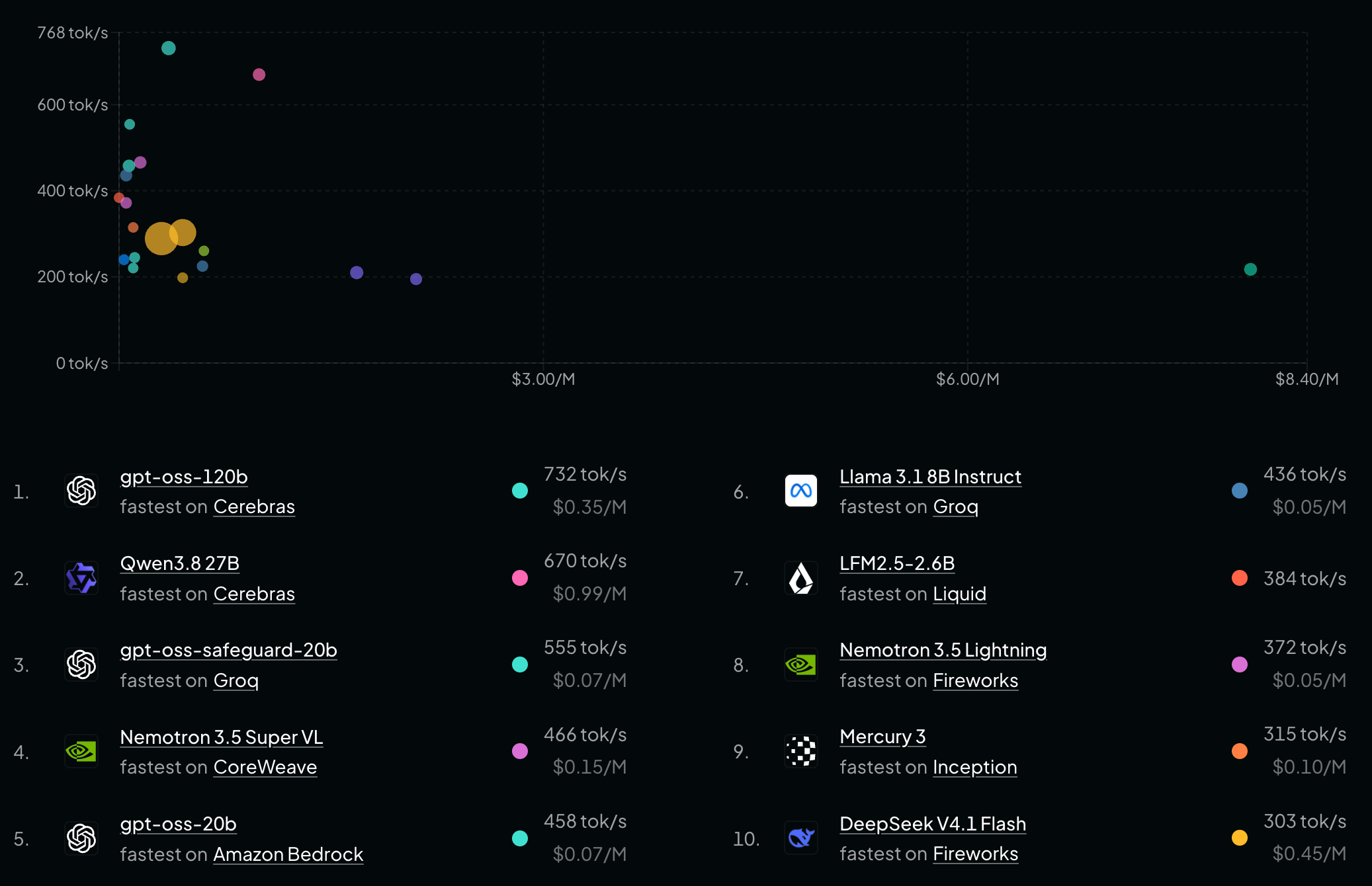
Beyond the lead in technical specs, on the GPT-OSS model, even though Cerebras’s tokens carry the highest unit price, they still hold roughly a 10% share.
Cerebras’s commercial partnerships with AMD, Amazon AWS, and Oracle Cloud are still ongoing.
So I’m inclined to think that Cerebras’s current stock troubles are temporary, driven more by market panic (including worries about Cerebras and the neo-clouds) and by the influence of short sellers.
The analysis above doesn’t prove my judgment is right either. The most fundamental problem is the lack of a positive estimate of Cerebras’s market value. Position sizing is another issue: for a company that carries risk and hasn’t been fully validated, investing with a heavy position inevitably means enormous risk, and that approach must be wrong.
So far, I’m still not sure whether Cerebras can really take off. I have confidence in its technical strength, but I also doubt whether I’ve fully considered all the factors. In the end, value investing comes down to just how accurately you can see.